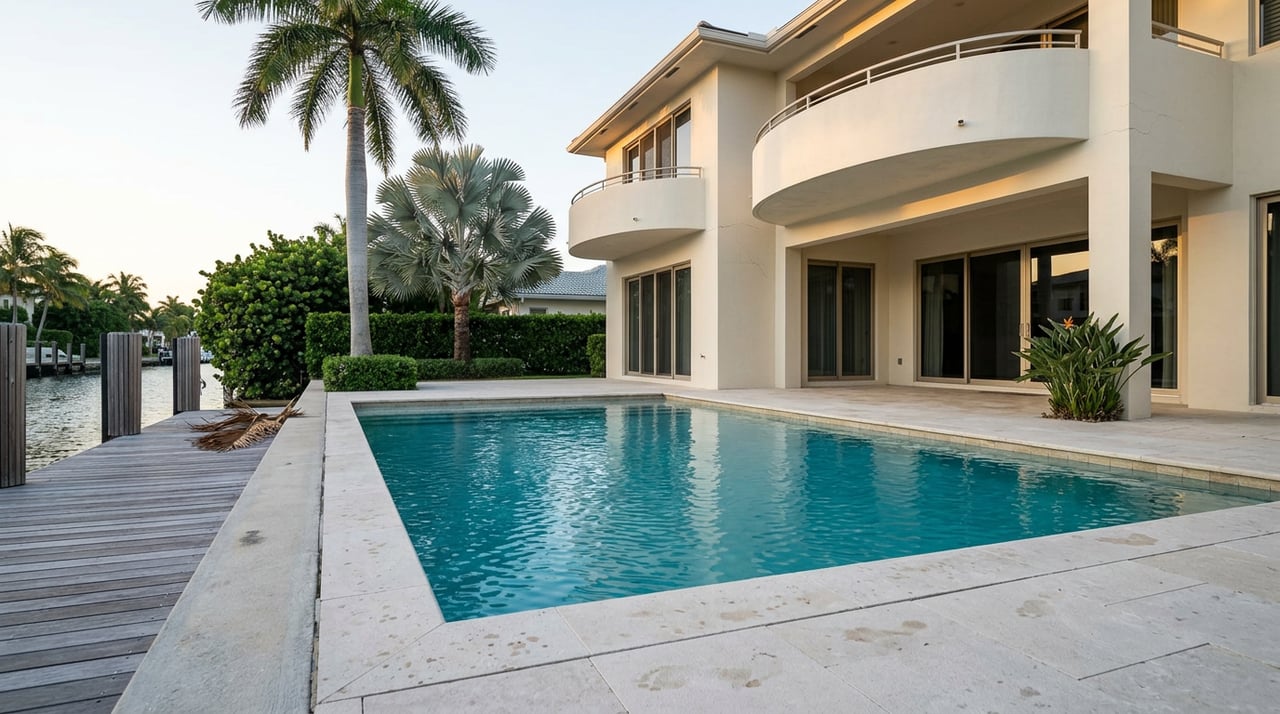
Every listing sheet in Las Olas Isles says some version of the same three words: no fixed bridges. It's the phrase that turns a nice canal home into a seven or eight figure asset, because it means a boat can leave a private dock and reach the Atlantic without ever measuring itself against a low overhead span. For a yacht owner, that phrase is the whole pitch.
Right now, for anyone whose route to open water crosses the East Las Olas Boulevard bridge over the Intracoastal, that pitch comes with a footnote nobody is printing on the listing sheet.
The Bridge Everyone Means When They Say "No Fixed Bridges"
The East Las Olas Boulevard bridge is the drawbridge most Las Olas Isles boats have to clear to reach the ICW and, from there, Port Everglades Inlet. It has been under a formal rehabilitation since January 5, 2026, a project the Florida Department of Transportation expects to run through roughly February 2027. The scope is real, structural work: a new solid aluminum deck, repainting the structural steel, replacement of the electrical components and the mechanical span locks that hold the two leaves together when the bridge is down, and replacement of the marine fenders and timber piles in the water itself. The project is run by FDOT construction project manager Jesus Sarmiento and project administrator Greg Spelios, and the agency has posted the full scope on its own project page.
That work has consequences for anyone on the water, not just drivers stuck in a detour. A navigation alert filed for the project spells out three operational changes that stay in place for the duration of construction. A containment system around the work area reduces vertical clearance by three feet. The channel is only partially open, and a full passage requires two hours of advance notice. And the bridge itself is currently authorized for single-leaf openings, meaning the full swing that a taller vessel needs to clear it is not the default, it's a request.
None of that shows up in a listing that says "no fixed bridges, direct ocean access." It shows up on a Coast Guard navigation alert and a city traffic advisory, and it has been active enough to generate real closures this summer, including overnight lane closures in mid-July and a full 48-hour bridge closure in early August that Fort Lauderdale's own traffic advisories confirmed as part of the ongoing rehabilitation.
Not Every Bridge in the Isles Is This Bridge
Here's where a buyer's due diligence gets specific instead of general. Las Olas Isles is not served by one bridge. It's a cluster of canals branching off streets that include Mola Avenue, Isle of Capri Drive, Bontona Avenue, Lido Drive, San Marco Drive, Coral Way, Royal Plaza Drive, Isle of Palms Drive, and Coconut Isle Drive. A dock on one of those streets might route to open water past the East Las Olas Boulevard bridge. A dock on another might route through an entirely different structure.
That second category matters because the city and FDOT have also run a separate infrastructure program called Bridges of the Isles, covering the interior spans at Nurmi Drive, Fiesta Way, Isle of Venice, and Royal Palm Drive, along with the Sunrise Key Boulevard bridge. That program's public meeting notes describe those interior spans on their own construction schedule, distinct from the East Las Olas Boulevard structure over the ICW. It is a different bridge, or set of bridges, on a different clock than the ICW rehabilitation running into 2027.
The practical upshot: a Las Olas Isles property is not affected by "the bridge situation" as a single fact. It's affected by whichever specific bridge sits between that dock and the water, and buyers should ask which one applies to their exact route before assuming any general statement covers the whole neighborhood. A buyer who asks a general question gets a general, reassuring answer. A buyer who asks which structure their route actually crosses gets a specific one, tied to a specific project.
What the Price Data Is Actually Saying
Set the bridge aside for a moment and look at what's happening to Las Olas Isles values on paper, because the two stories connect.
As of January 2026, median sale prices in Las Olas Isles were up about 12.8% year over year, landing near $4.0 million. That sounds like a market on fire. Read one line further and the picture complicates itself: homes were taking a median of 218 days to sell, almost double the 100-day median from the same month a year earlier, and only five homes closed in the neighborhood that month.
That's a market where the headline number and the actual buyer behavior are telling different stories. Prices are rising in a sample so thin that a single large sale can move the median on its own, while the time it takes to actually get a deal done has stretched considerably. Layer in the gap between what sellers are asking and what's closing: as of August 2026, the median list price for a Las Olas Isles home had climbed to $7,999,999, up from $4,900,000 the same month a year earlier, while sales that actually close have been landing closer to $4.0 million. That's not necessarily a sign the market is soft. It's a sign that list price in this segment functions more as an opening position than a comp, and that the properties actually transacting are getting there through real negotiation, not through matching the sign in the yard.
A buyer weighing Las Olas Isles against other Fort Lauderdale ocean-access enclaves like Rio Vista or Harbor Beach should treat that days-on-market number as more informative than the median price. Rising prices with rising time on market usually means the pool of qualified, motivated buyers for a specific type of asset is smaller than the price trend implies. It also means a well-priced, turnkey property with genuinely clear water access still moves. The properties sitting the longest tend to be the ones asking a "no fixed bridges" premium without current, verifiable proof that the route out is actually unencumbered right now.
Before You Write an Offer on a Las Olas Isles Dock
The fix for all of this is not complicated, it just requires asking a more specific question than the listing answers. Before you make an offer on any waterfront property in the Isles:
- Get your vessel's air draft and draft depth in writing, and don't rely on the listing's stated dock dimensions alone.
- Ask which bridge stands between that specific dock and open water, by name, not by the general claim of "no fixed bridges."
- If the route crosses the East Las Olas Boulevard bridge, confirm the current clearance reduction and the two-hour notice requirement for a full opening, since that structure remains under active rehabilitation into 2027.
- If the route crosses one of the interior spans covered by the Bridges of the Isles program, ask for the current completion status of that specific bridge rather than assuming the whole program wrapped on schedule.
- Treat the listing price as a starting point for negotiation, not a market comp, given how far current median list prices are running above median sale prices in this neighborhood.
- Ask when the listing agent last confirmed clearance and channel status directly with the Coast Guard or a local marine surveyor, rather than repeating language from an older listing description.
None of this makes Las Olas Isles a worse place to buy. The scarcity that drives its value is real. Deep water on a finite stretch of canal does not get created, and demand for it is not going away. What's true right now is that the neighborhood's signature promise, direct and unencumbered ocean access, is temporarily conditional on which bridge your dock actually depends on and what that bridge's construction calendar says. A buyer who verifies that before closing is negotiating from a position most other buyers in this market aren't.
A Few Questions Worth Settling Early
Does the East Las Olas Boulevard bridge rehabilitation affect every Las Olas Isles property? No. It affects properties whose route to the ICW and Port Everglades crosses that specific bridge. Docks that route through other channels may be unaffected by this project, though they should still be checked against the separate Bridges of the Isles work.
Is the three-foot clearance reduction permanent? No. It's tied to the containment system used during construction, which FDOT expects to have in place through roughly February 2027, based on the current navigation alert for the project.
Does a longer days-on-market figure mean prices are falling? Not necessarily. In Las Olas Isles, rising median prices and rising days on market have shown up in the same data at the same time, which points to a thin, selective luxury pool rather than a declining market.
Cross-border buyers in particular tend to price these details into their offers once they see them in writing, because the alternative, discovering a bridge restriction after closing, is exactly the kind of surprise a considered purchase is supposed to avoid. If you're comparing Las Olas Isles to other Fort Lauderdale waterfront enclaves and want the bridge, clearance, and pricing specifics run down street by street before you write anything, Roman Tschannen can walk through the current status with you and help you request a private consultation.