In a Phys.org report, Fort Lauderdale City Commissioner John Herbst said, "These are not folks that need government welfare."
He made the remark while arguing against the city's own proposal to help waterfront owners pay for seawall permits. He supported the program in principle. He objected to the city kicking in money for people who already own million-dollar canal frontage. The proposal passed anyway, and this year Fort Lauderdale launched its Living Seawall Permit Fee Assistance Program. But Herbst's objection is worth sitting with, because the numbers behind that program show how much of the real cost of owning a Fort Lauderdale seawall the assistance covers, and how much of it lands on whoever signs the closing documents.
If you are buying or selling waterfront property in Fort Lauderdale, that gap is the deal. Not the dock, not the view, not the boat lift. The wall.
A Private Liability With a Public Deadline
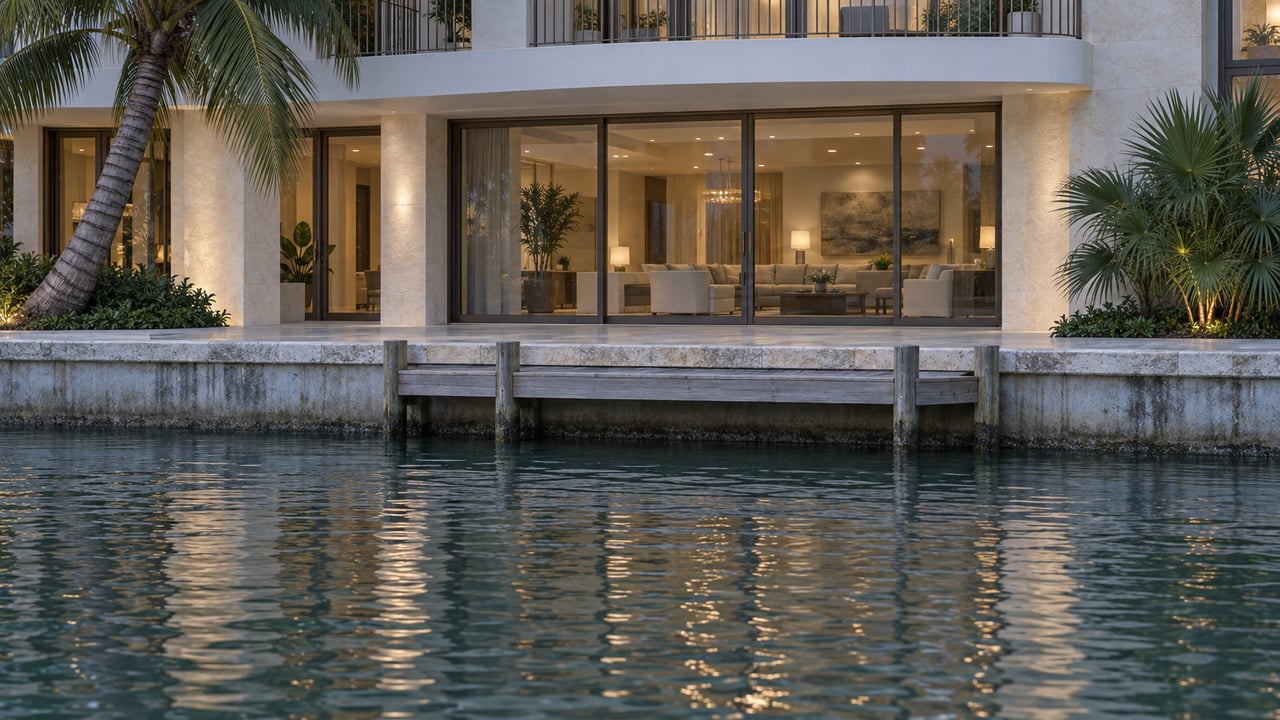
Fort Lauderdale earns its "Venice of America" reputation honestly. According to Waterfront Times, roughly 200 miles of seawall line the city's canals and Intracoastal frontage, and the majority of that belongs to private property owners rather than the city. That means the seawall in front of a listing in Rio Vista, Colee Hammock, or along the New River is not a shared municipal asset. It is a private structure that happens to hold back public water.
Broward County set a countywide elevation standard in 2020 requiring seawalls and top-of-bank elevations to reach 5 feet by 2050. The trigger that actually forces an individual owner to comply sooner is more specific: once a permitted repair covers more than half the linear length of an existing wall, the new height standard applies immediately. A wall that finally needs real work gets pulled into 2050's deadline overnight.
That distinction matters for a buyer more than the deadline itself. A seawall built in the 1960s and never substantially repaired can look, on paper, like a wall with three decades of runway left. In practice it may be one storm season away from a repair that trips the 50 percent threshold, at which point the new owner inherits both the damage and the compliance obligation in the same transaction.
Why No Two Estimates for the Same Wall Agree
Ask three marine contractors what a Fort Lauderdale seawall costs and you will get three different numbers, and none of them are lying. The city's own contractor survey, still the figure most often cited, put replacement at $650 to $2,000 per linear foot. Current 2026 pricing guides for Broward and Palm Beach counties widen that range dramatically, from about $2,000 for a minor crack repair to more than $80,000 for a full replacement on a longer wall, depending on water depth, soil conditions, and whether the contractor can work from land or has to barge equipment in from the water.
Marco Aguilera, the city's chief waterways officer, gave commissioners a simpler anchor point during last year's commission discussion of the incentive proposal: the average full seawall installation in Fort Lauderdale runs about $100,000. Multiply that across a 200-mile private seawall system and the scale of the obligation becomes clear. It also becomes clear why a single "cost per linear foot" figure pulled from a general contractor's website is close to useless without an actual inspection. The same 100 feet of wall could need a $5,000 crack seal or a $150,000 rebuild, and a listing price has no way of telling you which.
What the Incentive Program Actually Buys
This is the context that makes the new incentive program worth reading closely. Fort Lauderdale's Living Seawall Permit Fee Assistance Program set aside $50,000 total, split evenly between residential and commercial projects, and capped assistance at $3,500 per residential project and $7,000 per commercial one. The fund covers the base permit fee, which the city calculates at 1.75 percent of a project's job cost. On Aguilera's $100,000 average installation, that fee runs about $1,750, which the program now waives entirely.
Run the arithmetic and the program's actual leverage becomes visible. A $1,750 fee waiver on a $100,000 project is worth roughly 1.75 percent of the total cost. It is real money, and it is worth taking if you qualify, but relative to the full project cost, it may influence a homeowner's choice between a living seawall and a conventional one once they have already decided to rebuild.
That framing matches what happened before the incentive existed. Between October 2023 and October 2025, Fort Lauderdale issued 176 seawall permits. Exactly one was for a living seawall. The $50,000 fund, as Aguilera pointed out to commissioners, could cover about 28 living seawall permit fees before running out, which tells you the program is sized for a modest shift in behavior at the margin, not a wholesale change in how the private seawall market operates. If you are evaluating a waterfront property this year, the figures suggest conventional concrete or vinyl walls remain far more common. The incentive is a nudge toward the newer material, not a subsidy for the underlying six-figure decision every owner eventually faces.
A Living Seawall Project with Private Construction Funding
The most visible living seawall project in Fort Lauderdale right now is largely privately financed, although it did receive the city's permit-fee waiver. The Church-by-the-Sea, located east of the 17th Street Causeway on the barrier island, is rebuilding 980 linear feet of aging seawall using the 3D-printed, mangrove-inspired panels made by Miami-based Kind Designs. The project carries a $1.75 million price tag, funded almost entirely through private donations from the congregation, some given from as far away as Australia, and the church says it has raised close to $1.6 million toward it. Construction is expected to break ground soon and finish in spring 2027.
It is worth noting that the church did use the city's fee waiver. But the waiver covers permitting costs, not the $1.75 million construction bill. The congregation's donations, not the waiver, covered that cost. That is the pattern worth remembering if a listing agent mentions a "living seawall option" as an amenity: the technology exists and the city waives eligible permit fees, but the fee waiver does not cover construction costs.
The city's own infrastructure priorities add a final layer of context. A collapsed section of the public Riverwalk along the New River, damaged by an aging seawall that let soil erode from underneath the pavers, has been barricaded since this summer, and city officials have said the repair will not begin until 2027 because it ranks second on the municipal seawall replacement master plan. If the city's own priority list for the seawalls it does own stretches years out, private owners waiting on permits, contractors, or financing for the rest of the system should plan accordingly.
Before You Write an Offer
If you are close to buying or selling waterfront property in Fort Lauderdale, a few questions belong in the contract stage rather than after closing:
- Ask when the seawall was last permitted for repair, and whether that repair covered more or less than half its linear length. That answer determines whether the current owner was ever required to meet the 5-foot standard.
- Request an actual marine inspection rather than a visual walk-through. A wall that looks fine above the waterline can be losing soil beneath it, the same failure mode behind the Riverwalk collapse.
- If a seller markets a wall as recently replaced, confirm the material and height on the permit record rather than taking the listing's word for it.
- Do not assume the city's fee waiver changes your budget materially. Price the wall as if the incentive did not exist, then treat any credit as a bonus.
None of this is about rating Fort Lauderdale's waterfront as risky. It is one of the most established boating markets in the country for good reason. It is about pricing the one piece of the property that almost never shows up in the listing photos, and negotiating it the way you would any other structural item with a six-figure range attached to it.
If you are evaluating waterfront property in Fort Lauderdale, whether that means a canal-front home in Rio Vista or a New River address near downtown, Roman Tschannen can walk you through what a specific seawall's history and condition actually mean for your offer. Request a private consultation to start that conversation before you write the number.
This article is general information, not legal, tax or financial advice. Consult a qualified professional about your situation.